

Free Keyword Research Tool
What Is a Keyword Research Tool and Why Do You Need It?
A keyword research tool is a simple software that shows you which words and phrases people search for online. It tells you how many people search for a word every month. It also tells you how hard it is to rank for that word on Google.
You need it because guessing does not work anymore. Google processes over 8.5 billion searches every single day. Without the right keywords, your content gets lost in that crowd. A keyword research tool gives you real data so you can make smart decisions.
It helps you find search terms that your target audience actually uses. Then you can write content around those terms and start showing up in Google results.
How Does a Keyword Research Tool Actually Work?
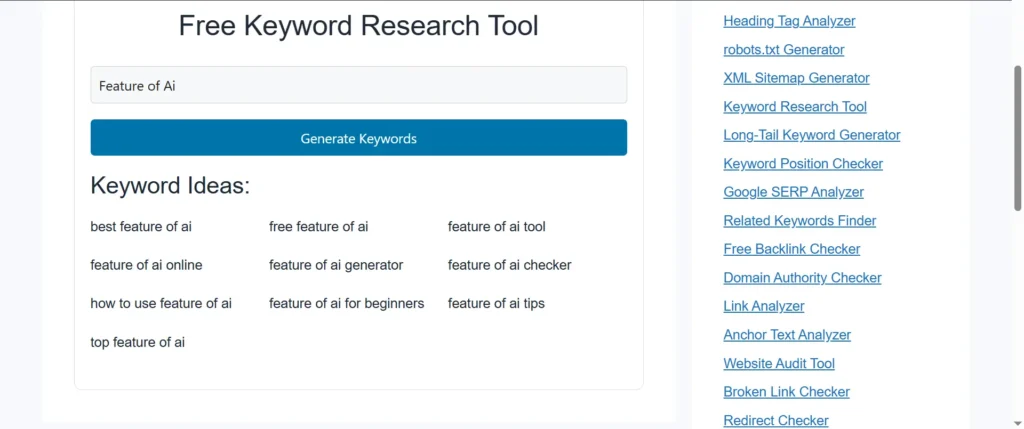
A keyword research tool works by taking a word or phrase you type in and then generating a big list of related keyword ideas. It pulls data from search engines and shows you useful information like search volume, keyword difficulty, and search intent.
Here is what each thing means in simple words.
Search volume tells you how many people search for a keyword in a month. A keyword with 10,000 monthly searches is very popular. A keyword with 100 monthly searches is a smaller opportunity. Keyword difficulty tells you how tough it is to rank for that word. A low difficulty score means you can rank without too much effort.
A high difficulty score means big websites already dominate that topic. Search intent tells you what a person really wants when they search. Do they want to buy something? Do they want to learn something? Do they want to visit a specific website? A good keyword research tool helps you understand this so your content matches what people need.
Why Is Keyword Research Important for SEO?
Keyword research is the foundation of SEO. Without it, you are just writing content and hoping someone finds it. With it, you write content that Google actually wants to show to people. Good keyword research helps you attract the right visitors to your website. These are people who are already looking for what you offer.
That means they are more likely to read your content, trust your brand, and even buy from you. It also helps you find gaps in your market. You can discover topics that your competitors have not covered yet. When you write about those topics first, you get a head start in the rankings. Keyword research also protects you from a common mistake called keyword cannibalization.
This happens when two or more pages on your website target the same keyword. It confuses Google and hurts your rankings. A keyword research tool helps you plan your content so every page targets a unique keyword.
What Features Should a Good Keyword Research Tool Have?
A good keyword research tool gives you more than just a list of words. It gives you the information you need to pick the best keywords for your website. The tool should show you accurate search volume data so you know how popular a keyword is. It should give you a keyword difficulty score so you can choose battles you can win.
It should suggest long-tail keywords, which are longer and more specific phrases that are easier to rank for. It should also show you related keywords and semantic keywords. These are words that are connected to your main keyword in meaning. When you use them in your content, Google understands your topic better and ranks your page higher.
A great keyword research tool also helps you see what your competitors rank for. This competitive analysis feature saves you hours of manual work. You can spot keyword opportunities your competitors already found and then write better content to outrank them.
Try Other Free SEO Tools:
How Do You Use a Keyword Research Tool Step by Step?
Using a keyword research tool is easier than it sounds. You follow a few simple steps and you come out with a strong keyword list.
First, you type in a seed keyword. A seed keyword is a short, broad word related to your topic. For example, if you run a baking blog, your seed keyword might be “chocolate cake.”
Second, the tool generates a large list of keyword ideas. You see related terms, question-based keywords, long-tail variations, and more. The tool shows the search volume and difficulty for each one.
Third, you filter the list. You look for keywords with decent search volume but low difficulty. These are your best opportunities because you can rank for them without competing against giant websites.
Fourth, you analyze the search intent behind each keyword. Make sure the keyword matches the type of content you want to create.
Fifth, you build your content plan around the keywords you picked. You create one piece of content for each main keyword. You support it with related keywords throughout the page.
This simple process helps you build a content strategy that gets real results on Google.
What Are Long-Tail Keywords and Why Do They Matter?
Long-tail keywords are longer, more specific keyword phrases. Instead of “shoes,” a long-tail keyword might be “best running shoes for flat feet.” They usually have lower search volume, but they also have lower competition.
Long-tail keywords matter a lot for small and new websites. When you are just starting out, you cannot compete with huge websites for popular one-word keywords. But you can win with specific long-tail terms because fewer websites target them.
People who search long-tail keywords also know exactly what they want. They are closer to making a decision or a purchase. That means they convert better than people who search broad keywords.
A good keyword research tool makes it easy to find hundreds of long-tail keyword ideas from a single seed keyword. This gives you a roadmap of content topics that can bring consistent traffic over time.
What Is the Difference Between Free and Paid Keyword Research Tools?
Free keyword research tools give you basic data like keyword ideas and general search volumes. They are perfect for beginners, small website owners, bloggers, and anyone who wants to get started without spending money.
Paid keyword research tools give you deeper data. They show more accurate search volumes, detailed competitor analysis, keyword gap reports, and advanced filters. Platforms like Ahrefs and Semrush are popular choices among SEO professionals and agencies.
The best approach is to start with a free keyword research tool and learn the basics. Once your website grows and you need more detailed data, you can move to a paid tool. Many free tools give you enough information to build a solid SEO strategy without spending a dollar.
How Do You Pick the Best Keywords for Your Website?
Picking the best keywords comes down to three things. You want keywords that are popular, not too difficult to rank for, and relevant to your content.
SEO experts call this the keyword tripod rule. If any one of those three things is missing, the keyword becomes weaker. A popular keyword with high difficulty is hard to win. A low difficulty keyword with no search volume brings no traffic. A keyword with great volume and low difficulty but no connection to your business brings the wrong visitors.
You also want to check the search intent. If Google shows product pages for a keyword, it expects transactional content. If it shows blog posts and guides, it expects informational content. Match your content type to what Google already rewards.
Finally, look for keywords your competitors rank for but your website does not. These keyword gaps are golden opportunities. A keyword research tool finds these gaps quickly so you can act on them faster than your competition.
How Does Keyword Research Connect to Content Strategy?
Keyword research and content strategy work hand in hand. Your keyword research tells you what to write. Your content strategy tells you how and when to write it.
The best approach in today’s SEO is called topic clustering. Instead of writing random articles, you build clusters of content around one big topic. You write a main pillar page that covers the broad topic. Then you write smaller supporting articles that go deep on each subtopic. All of them link together.
This approach tells Google that your website is an authority on that topic. It builds what SEO professionals call topical authority. The more authority you build, the better all your pages rank.
Your keyword research tool helps you find the main topic, all the subtopics, and the supporting keywords for each article. It turns keyword data into a complete content roadmap.
Can Beginners Use a Keyword Research Tool Without SEO Experience?
Yes, absolutely. A good keyword research tool is built for everyone, not just experts. You do not need to know advanced SEO to get real value from it.
You simply type in a word related to your business or blog. The tool does the heavy lifting. It shows you the data in a simple, easy-to-read format. You pick the keywords that make sense for your content and start writing.
As you use the tool more often, you start to understand the numbers better. You learn what search volume means for your niche. You learn which difficulty scores are realistic for your website. Over time, your keyword skills get stronger naturally.
Beginners who start with keyword research from day one build a much stronger foundation than those who skip it. It is one of the smartest habits you can develop as a website owner or content creator.
FAQs
What is a keyword research tool?
A keyword research tool is software that helps you find the words and phrases people search for on Google. It shows search volume, keyword difficulty, and related keyword ideas so you can create content that ranks.
Is there a free keyword research tool available?
Yes. There are many free keyword research tools available online. They give you keyword ideas, search volume data, and basic metrics without any cost. Free tools are perfect for beginners and small website owners.
How do I use a keyword research tool for SEO?
You type a seed keyword into the tool. It generates a list of related keyword ideas with data. You pick keywords with good search volume and low competition, then build your content around them.
What is the best free keyword research tool?
Several tools offer strong free features. Google Keyword Planner, Ubersuggest, and the free keyword research tool at thetopfile.com are popular choices for beginners looking to find keyword opportunities without paying.
What is search volume in keyword research?
Search volume tells you how many people search for a specific keyword in a month. Higher search volume means more people look for that term, which can bring more traffic to your website if you rank for it.
What is keyword difficulty in a keyword research tool?
Keyword difficulty is a score that tells you how hard it is to rank for a specific keyword on Google. A lower score means less competition. A higher score means stronger websites already dominate that search result.
What is the difference between short-tail and long-tail keywords?
Short-tail keywords are broad, one or two-word phrases like “shoes.” Long-tail keywords are longer and more specific, like “best running shoes for flat feet.” Long-tail keywords are easier to rank for and attract more targeted visitors.
Why is keyword research important for SEO?
Keyword research helps you find the exact words your audience uses on Google. When you use those words in your content, Google understands your page better and shows it to the right people. Without keyword research, your content is hard to find.
How many keywords should I target on one page?
You should focus on one primary keyword per page. You can also add several related keywords and semantic terms throughout the content to help Google better understand your topic.
Can AI tools replace keyword research tools?
AI tools can help you brainstorm keyword ideas, but they cannot replace a dedicated keyword research tool. AI does not provide accurate search volume or keyword difficulty data. You always need a real keyword tool to validate your keyword choices.